

From Earth to Orbit: What the Artemis Mission Teaches Us About the Future of Vertical Farming
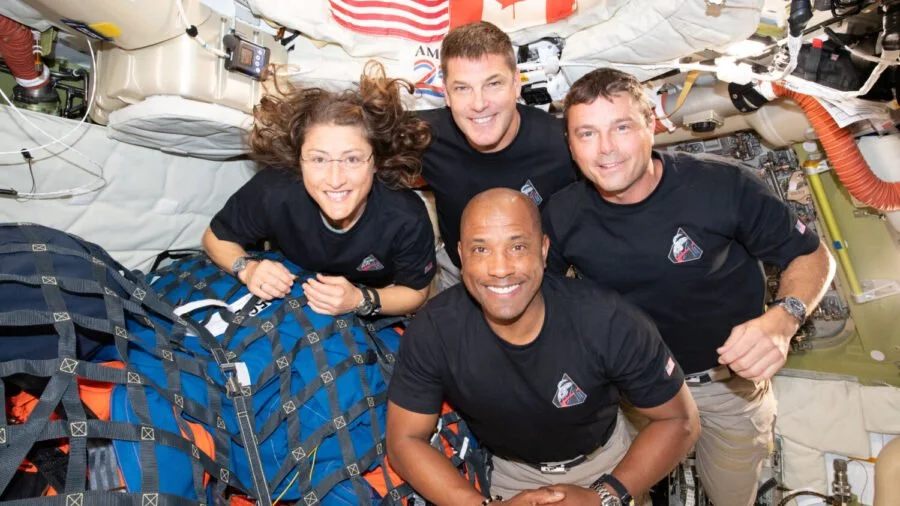
(clockwise from left) Mission Specialist Christina Koch, Mission Specialist Jeremy Hansen, Commander Reid Wiseman, and Pilot Victor Glover (Photo by NASA via Getty Images)
Last week, four astronauts splashed down in the Pacific after completing humanity's first crewed journey to the Moon since 1972. The Artemis II mission — ten days, 695,000 miles, one lunar flyby — was a reminder that the hardest engineering challenges tend to ask the most fundamental questions.
I’ve been thinking about that question a great deal lately. Not from a distance, but from the inside. Clean tech and green tech are areas I’ve worked in closely for years — advising boards, speaking at conferences and leadership forums globally on clean tech leadership and the energy transition, and sitting as an adviser and Non-Executive Director for Take Root Bio, a company working at the intersection of controlled environment agriculture and the kind of operational precision that long-duration space missions will ultimately demand. Their work is already shaping how we think about vertical farming technology on Earth — but the Artemis programme is a compelling lens through which to understand why that work matters.
As NASA’s Artemis mission ushers in a new era of human exploration around the Moon — and lays the groundwork for future missions to Mars — it is forcing scientists, engineers, and policymakers to confront a challenge that is surprisingly familiar to vertical farmers here on Earth: how do we reliably grow fresh food in the most extreme environments imaginable?
Beyond propulsion systems and spacecraft design, long-term space exploration depends on something far more fundamental — sustainable food production. Astronauts cannot rely indefinitely on packaged meals shipped from Earth. For lunar bases and eventual Martian settlements to succeed, fresh vegetables must be grown locally, efficiently, and with minimal waste. The solution increasingly points to controlled environment agriculture (CEA) and vertical farming systems, not unlike those already transforming agriculture on our own planet.
At Take Root Bio, this parallel is more than theoretical. The same principles that enable profitable vertical farms on Earth — data-driven decision-making, environmental precision, and operational efficiency — may ultimately define how humanity feeds itself beyond it.
Why does space need vertical farming technology?
The Moon and Mars present agricultural conditions far harsher than any desert, tundra, or urban environment on Earth. There is no usable soil, minimal water, extreme temperature variation, radiation exposure, and limited energy availability. Traditional farming is not an option.
Instead, food production in space must be:
• Fully enclosed
• Highly automated
• Optimised for minimal resource use
• Predictable and resilient
These requirements align almost perfectly with modern vertical farming. In fact, many space agencies now view vertical farms not just as an agricultural solution, but as a life-support system — supplying food, oxygen, and psychological well-being to astronauts living off-world.
Prototype concepts already envision containerised vertical farm modules that could be transported to lunar or Martian surfaces, where crops are grown hydroponically or aeroponically under tightly controlled conditions.
Controlled conditions: the great equaliser for clean tech businesses
Whether on Earth or in orbit around the Moon, successful crop production depends on managing a precise balance of variables:
• Light intensity and spectrum
• Temperature and humidity
• CO₂ concentration
• Nutrient composition
• Water availability
In space, mistakes are not merely costly — they can be mission-critical. There is no margin for inefficiency or crop failure. This is why software-driven environmental control is becoming as important as physical infrastructure
Here on Earth, vertical farmers and clean tech businesses face similar pressures. Rising energy costs, labour shortages, and narrow profit margins demand systems that can continuously optimise growing conditions. The difference is one of degree, not kind.
The core challenge is the same: how do you turn environmental complexity into repeatable, profitable yields?
Data is the real fuel: lessons for green tech investment
Space agencies understand that farming off-world will be fundamentally data-led. Sensors will monitor every aspect of plant growth, feeding real-time insights into automated systems capable of adjusting conditions instantly. Human intervention will be limited, intentional, and strategic.
This mirrors the direction of successful vertical farming businesses and clean tech investment today.
At Take Root Bio, data is not a “nice to have” — it is the backbone of modern agriculture. Sophisticated farm management platforms can:
• Identify inefficiencies before they become costly problems
• Correlate environmental variables with crop performance
• Standardise best practices across multiple sites
• Enable predictive decision-making rather than reactive firefighting
In space, these capabilities are essential for survival. On Earth, they are essential for profitability.
Efficiency is not optional: the defining challenge for green tech businesses scaling up
Every gram launched into space carries enormous cost, making resource efficiency a non-negotiable priority. Water must be recycled, nutrients recovered, and energy usage optimised down to the smallest unit.
This same pressure is now shaping commercial vertical farming and the broader clean tech business landscape.
Margins in controlled environment agriculture are tight, and efficiency determines whether a farm scales or fails. Energy is often the single largest operating expense. Poor environmental control leads to suboptimal yields. Inconsistent processes make performance unpredictable.
The lesson from Artemis is clear: future agriculture — on any planet — must be lean by design.
By combining software, sensors, and consultancy expertise, vertical farmers and green tech businesses can identify where resources are being lost and where returns can be improved. Efficiency is not just about lowering costs; it is about creating systems that consistently deliver high-quality crops at scale.
Resilience through redundancy and design: what clean tech leadership can learn from space
One of the major design principles of space systems is redundancy. Things will go wrong; what matters is how well the system absorbs and responds to failure.
Vertical farms and clean tech operations increasingly require the same mindset.
Disease outbreaks, equipment failures, power interruptions, or supply chain disruptions can derail production. A resilient operation is one that uses monitoring, alerts, and contingency planning to maintain operations despite unforeseen challenges.
Artemis reminds us that resilience is not accidental — it is engineered. Software plays a critical role by making the invisible visible, giving operators the insight they need to respond quickly and decisively.
Why does fresh food matter beyond nutrition?
Beyond nutrition, space agencies recognise the psychological importance of growing plants in isolated environments. Greenery provides routine, sensory stimulation, and a sense of connection to Earth — factors that significantly impact mental health during long missions.
This insight resonates strongly on Earth as well.
Urban vertical farms are not just efficient food factories. They reconnect people with how food is grown, shorten supply chains, and improve food security in cities where access to fresh produce may be limited.
In both contexts, vertical farming is about much more than yield. It is about creating sustainable, human-centred food systems.
What does the Artemis mission mean for the future of clean tech and vertical farming?
The technologies being developed for lunar and Martian agriculture will not remain in space. Historically, space research has driven innovation across energy, materials, and computing. Agriculture will be no different.
As governments invest in extreme-environment food systems, insights will flow back to Earth-based growers — improving lighting efficiency, automation, closed-loop systems, and biological understanding.
Vertical farming companies and clean tech businesses that embrace data, optimisation, and operational discipline today will be best positioned to benefit from this knowledge tomorrow.
Rooted on Earth, designed for the future
Take Root Bio exists to help vertical farmers turn complexity into clarity. By combining software and consultancy, we support growers in improving efficiency, increasing yields, and building businesses that last.
The Artemis mission is a powerful reminder that controlled environment agriculture is not a niche experiment — it is a cornerstone of humanity’s future.
Whether feeding astronauts on the Moon or communities here on Earth, the farms of tomorrow will be vertical, intelligent, and resilient by design.
And the work to build them is already underway.
Further information at Take Root Bio | Space Agriculture for Earth & Beyond
Working with clean tech and green tech businesses
If you are building or leading a business in clean tech, green tech or the broader energy transition, these are conversations I am already having — with boards, leadership teams and conference audiences globally. I speak regularly on the future of clean tech and what it demands of the organisations operating within it: the governance, the commercial discipline, and the quality of decision-making at the top. If that is relevant to your business, or if you are looking for a clean tech keynote speaker who understands this sector from the inside, I would be glad to hear from you. Get in touch.